Strategic Integration of Promotional Campaigns and Account Oversight for Improved Resource Distribution Across Affiliate Networks
Written by Frankie Bauer · Jul 26, 2026

Strategic Integration of Promotional Campaigns and Account Oversight for Improved Resource Distribution Across Affiliate Networks
Professionals in affiliate marketing have long recognized that linking promotional activities directly to account management routines creates measurable gains in how networks distribute budgets, time, and incentives. Data from multiple industry reports shows that programs which align campaign tracking with ongoing partner account reviews achieve higher conversion efficiency, while those that treat the two functions separately often encounter duplicated efforts and misallocated support. Observers note this pattern holds across both large-scale networks and smaller regional operations active in 2026.
Core Components of Integrated Practices
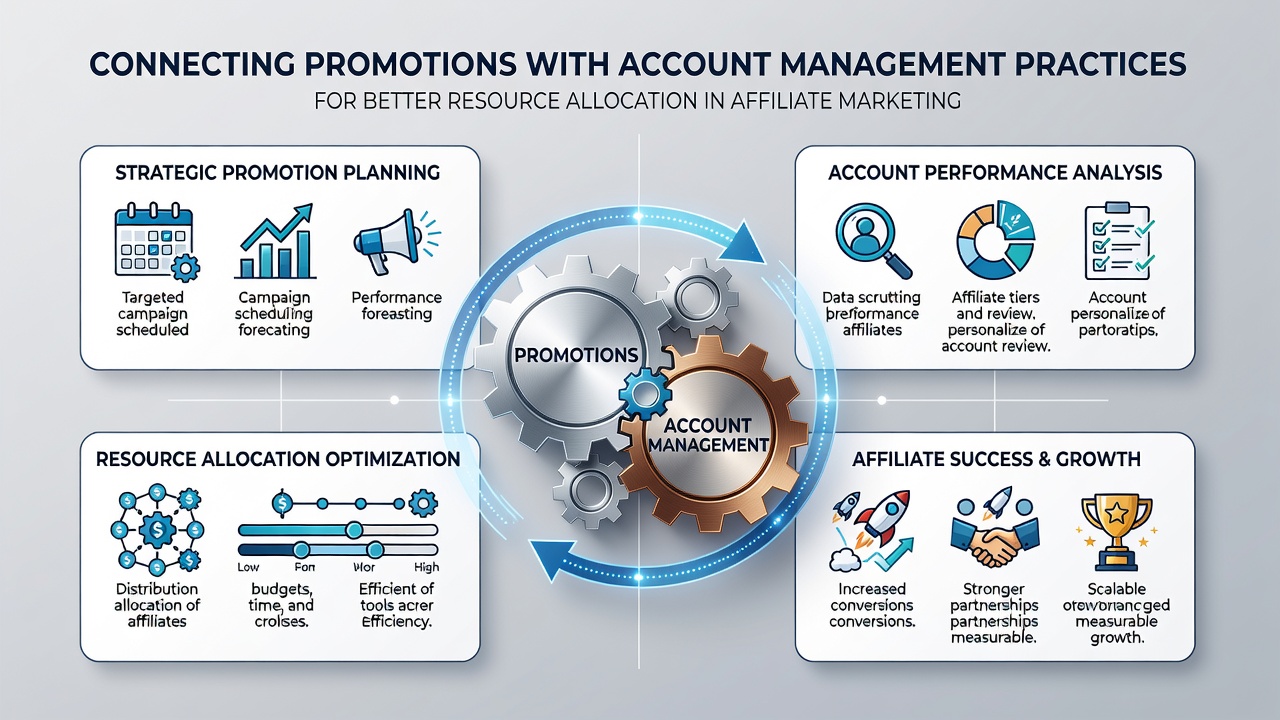
Account management teams maintain detailed records of partner performance, including traffic sources, conversion paths, and payout histories, while promotional teams design creatives, offers, and outreach sequences. When these groups share real-time data streams, resource decisions become more precise. For instance, a network that notices a partner’s email campaigns consistently outperform social posts can shift creative budgets toward email-optimized assets rather than spreading spend evenly. Research indicates such targeted reallocations frequently lift overall return on marketing investment by double-digit percentages within a single quarter.
Systems that connect these functions typically include shared dashboards displaying both campaign metrics and account health indicators. These platforms allow managers to flag underperforming segments quickly and redirect resources before losses compound. In July 2026 several networks reported adopting updated API connections between their promotion planners and account databases, resulting in faster identification of high-value partners and reduced time spent on low-yield outreach.
Resource Allocation Mechanisms
Effective allocation starts with performance thresholds that trigger automatic adjustments. When an account’s recent promotional activity meets predefined benchmarks, the system can approve additional ad credits or priority placement without manual review. Conversely, accounts showing declining engagement receive scaled-back support until metrics stabilize. This rule-based approach reduces administrative overhead and directs human attention toward partners who demonstrate sustained results.
Case examples from European and North American networks illustrate the impact. One operator that synchronized its bonus offer calendar with account scoring models discovered it could reduce total promotional spend by 18 percent while maintaining the same volume of qualified referrals. Another network applied similar logic to its tiered commission structure, moving funds from broad-based sign-up bonuses toward performance-tied incentives for accounts already delivering consistent traffic. Figures released by the Interactive Advertising Bureau reveal comparable efficiency gains across multiple digital marketing verticals when data pipelines between campaign and account functions remain open.
Implementation Considerations Across Regions
Networks operating in multiple jurisdictions must account for differing disclosure rules and data-handling requirements. Guidelines published by the Federal Trade Commission emphasize clear separation between promotional content and editorial material, which affects how account managers label and track partner communications. Meanwhile, frameworks from the Australian Competition and Consumer Commission stress transparency in performance reporting, encouraging networks to maintain auditable logs that link each promotional asset to specific account outcomes.
Technical integration often involves mapping promotional identifiers to account profiles so that every creative deployment carries traceable metadata. Teams that invest in this mapping early report fewer reconciliation issues during payout cycles and smoother compliance audits. Those who delay the connection frequently face manual data reconciliation that consumes staff hours better spent on strategy refinement.
Measuring Outcomes and Adjusting Over Time
Key performance indicators expand when promotions and account management share the same dataset. Networks track not only click-through and conversion rates but also the cost per active account and the lifetime value generated from each promotional channel. Periodic reviews of these combined metrics allow managers to retire underperforming assets and scale those aligned with high-value partners.
Academic work from the University of Nevada’s International Gaming Institute has examined how structured data sharing between campaign teams and account oversight functions correlates with steadier revenue streams for participating affiliates. The studies highlight that organizations maintaining quarterly alignment meetings between the two departments experience lower partner churn compared with those relying on separate reporting silos.
Conclusion
Networks that treat promotional planning and account management as connected processes rather than isolated tasks consistently demonstrate stronger control over resource distribution. By feeding performance data from one function into decision-making for the other, operators reduce waste, accelerate response times, and maintain clearer visibility into which partnerships merit continued investment. As reporting standards evolve and compliance expectations rise, the operational advantage of this integration is expected to widen further.